
• ToVa Weekend: Passwords As Mantras, Travel, Being Compelling

    Rupert is reading The Postman Always Rings Twice

    The weekend is here! Escape boredom over the weekend by finding a clever use of your password, reading over a few tips for short business trips and considering what characteristics make people compelling.


    How a password changed my life. (via)

    Here’s a touching story to go along with a clever idea for taking something mundane – any of the passwords you must type repeatedly during your day – and making it something significant. Simply using passwords as reminders (to forgive, to save) or mantras (quit smoking, don’t drink) changed Mauricio Estrella’s life and could change yours, too.


    The Busy Professional’s Guide to a One-Day Business Trip

    This one is pretty specific but the advice on offer is also great travel wisdom in general. Traveling light is key, but so is preparedness. It can be tempting to be a bit too casual about short trips but they actually require the most forethought – especially since you might end up stranded in an airport with no change of clothes!


    A Throwback Link Relevant To Our Interests…

    What Makes People Compelling

    This article seemed like a great way to conclude our week of self-defining and introspection. If strength and warmth are part and parcel of your character you will find people drawn to you in a meaningful way. Possessing and displaying one but not the other isn’t quite enough and executing both at the same time is definitely a challenge. Fortunately, the ultimate reward – the respect and trust of your peers – is totally worth the effort.


    ToVa Rewind:
    Define Yo Self Before You Refine Yo Self
    You Control Your Own Reality


    Rupert is reading: The Postman Always Rings Twice by James M. Cain


    Have a great weekend!


  • You Control Your Own Reality

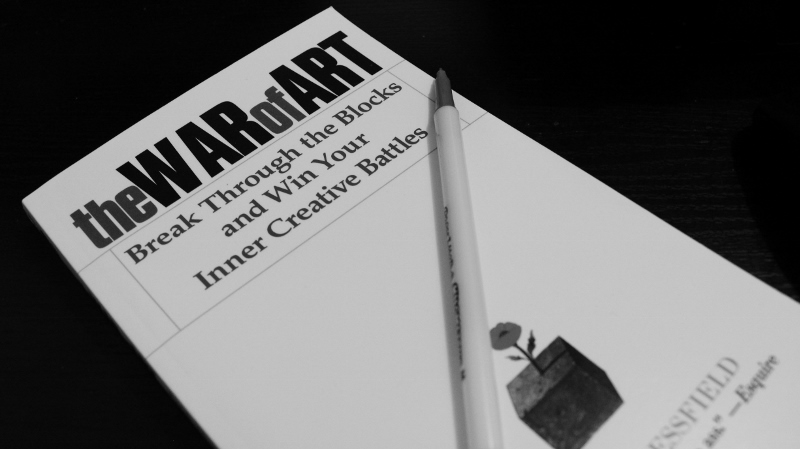
    The War of Art by Steven Pressfield

    The professional cannot allow the actions of others to define his reality.

    This quote appears in The War of Art by Steven Pressfield. It’s a must-own for creatives especially but will inspire anybody looking for some motivation. Slowly Pressfield explores the causes of creative resistance before urging you to “turn pro” and then guiding you through some pretty heady self-actualizing pondering. I can’t recommend the book enough and you’ll see Pressfield mentioned often on this blog and other personal development sites (in fact, an entry on his blog was a weekend reading suggestion of mine just last week). His ideas make sense and if his calls to action don’t mobilize you then, well, you may not have a pulse.

    The quote of the moment falls in line with our Monday discussion about defining yourself. Once you’ve figured out who you are and what you want to be (and do), one of the hardest obstacles to overcome will be other people. In the age of social media and instant feedback (you could go to the comments right now and tell me how you feel about this article) everybody is a critic and some are less thoughtful about it than others.

    Pressfield presents this quote after a story about Tiger Woods being distracted by a camera flash while playing in The Masters during his prime. Woods calmly stopped his swing, collected himself and drove the ball a mile down the fairway. Maybe the flash was a mistake, maybe it was intentional – but the reason wasn’t relevant to Woods and his reaction reflected that. The professional didn’t allow the action of another to enter the equation of his own success. Woods went on to win the tournament.

    How often in the course of your day do the actions of another person threaten to derail your day? Or week? Or career? Are you willing to cede that kind of control to other people? Jerks and critics will come and go but – as Pressfield says – you will have to continue to show up or else you’ll never realize your dreams. Others only have the control that you grant them, so be very careful about who you give that kind of power to.

    The next time somebody threatens to derail you – whether by accident or on purpose – remember that the only actions you can control absolutely are your own.

    Reset the mechanism and go about your business.


  • Define Yo Self Before You Refine Yo Self

    Rupert is defining himself quite literally.

    Defining yourself is the critical first step in establishing an ongoing and intentional program of personal development. Even if you consider yourself to be pretty self-aware, a little reflection might yield surprising results. If you fail to take the time to get this definition right you may find yourself swimming against the current in order to get somewhere you don’t actually want to be.

    You are complicated. I’m not saying this because I’ve seen your Facebook statuses about your ex, I’m saying it because who among us is so simple? Add external forces to the mix and you’re talking about a cocktail of personality that is rather difficult to reverse-engineer.

    But we’re going to try.

    Your Inherent Nature (And Nurture) Sets The Scene

    If I asked you to define yourself before we go any further, you would probably go straight for your hardwired traits:

    • Intro/Ambi/Extrovert
    • Shy versus outgoing
    • Type A or B personality
    • Creative or technical mind
    • Early riser or night owl

    Our brains are all wired differently and I’m sure you can pick one of the options on each of the above lines that describes how the synapses in your own brain fire.

    It’s important to understand these inherent elements of our personality because they are essentially permanent and incredibly difficult to overcome. Shy people can learn how to work a room, sure, but while working said room they will be fighting against their very chemistry and creating a cognitive dissonance that might lead to anxiety. Owners of a Type A personality can take a vacation like the rest of us but they may never be able to fully relax on that beach. Creatives have no time for trigonometry, night owls think the ‘sunrise’ is a fairy tale, etc., etc.

    Nurture also plays a significant role in the equation. My girl was born and raised in a city while I grew up in a rural area. The characteristics that were ingrained in our personalities as a result of these differing circumstances mean that we sometimes look at the same scenario in very different ways. Single children will have differing worldviews to those who grew up with siblings. Guys who had an older sister will grow up to be quite different than those who had a younger sister. The prism through which you develop your worldview will have a not insignificant impact on your personality. Even if the effect is subtle, it’s there.

    By understanding where you stand against all of these measures you can design your own development and steer yourself in the direction of a destination that will please your inner nature (and nurture).

    Understand How You Want To Be You

    I assume you have goals (you are reading a personal development blog, after all) but there are any number of avenues by which you might pursue those goals. Type A and B personalities again come into play with this concept. Type A are always on the go (hello, mobile readers!) and don’t sit still for too long before getting on with multitasking, while Type B are more laid back and happy to take things one at a time (hello, read-it-later gang!).

    This whole Type A/B idea is more of a theory than a hard and fast choosing of sides but it’s a good place to start when considering the manner in which you’d like to move ahead with your personal development. Do you prefer gold stars and rapid achievement or does slow and steady win the race for you?

    Context Changes More Than Just The Scenery

    However straightforward the core you may be, things get complicated when you consider the different contexts in which we all must operate at different times. When alone in your living room, I imagine it’s pretty easy to be you – but what about when you’re in any of these places:

    • Work
    • School
    • A family dinner
    • A friend’s birthday party
    • On the train

    I’m guessing that your behavior would vary across these different contexts. For example, our work self is not the same person that has dinner with our parents. The contexts can get even more specific still; the you that rides the train to work probably doesn’t chant and sing like the you that rides the train to a football game.

    If it all seems a bit two-faced (or five-faced, even) I guess that’s because… it is. But in this instance you’re not only allowed to get away with it, society would rather you get away with it. Ever had a boss that engaged in overshare about his sexual exploits? That’s an example of somebody who can’t keep his contextual selves within their appropriate contexts. Don’t be that guy – nobody likes that guy.

    There are many behaviors and traits that are appreciated across all contexts (like punctuality and patience), so this is naturally where you want to start. It only makes sense to allocate time to the areas that will yield the greatest harvest. However, once these universal traits have been addressed you can really get to work on maximizing each of your contextual selves. Learning to cook a dish isn’t going to advance your career but it’ll impress the hell out of your parents. Likewise, brushing up on your Excel skills will do wonders for your work self but won’t hold the attention of your girlfriend (spoken from experience).

    Sometimes The Context Gets Official

    Throughout your life you will encounter – and probably align yourself with – any number of organizations. These could include alumni associations, trade unions, social clubs, fraternities or even mastermind groups.

    I’ll dedicate more digital ink to associations and organizations in the future but they’re important to consider now and in the context of you because it is you who actively chooses to join them and the act of forming this association with an organization – whether passively or directly – reflects on you.

    Choosing to join Boy Scouts of America, for instance, is a direct, opt-in decision that implies your own values and beliefs align with those of BSA – otherwise you wouldn’t have signed up. Choosing to attend a particular university, on the other hand, is rather passive and suggests value alignment that may not be present. You might have attended a Catholic university because their chemistry program is tops, but people may assume that you’re Catholic (and thereby live by Catholic values) as a result of your decision to attend school there, even if that was never a factor that you considered.

    Whether directly or passively, these associations become part of the definition of you.

    And Oh, The Things You’ll Do

    The wild thing about all of this is that we’ve considered so much of what makes you you and we have only just scraped the surface of the actual things you get up to while being you. All of the activities in which you engage will speak volumes about you (actions speaking louder than words and that). Think about your high school friends who went to work and those who went to college. I’ve biased the result a bit by framing the exercise in this way but that fact – whether they studied or not – is probably a factor in your own impression of those people but all they’ve really done differently to each other is pursue different activities.

    Think about car decals. When you see stick figure families on the back of a car, you assume (without knowing anything else about that person!) that they are all about their family. Somebody with “26.2” on their car has run a marathon and – you’d be safe assuming – would include “running” in their own definition of self.

    What activities would be included in your own definition of self? What stickers are on your metaphorical back car window?

    • Education?
    • Cooking?
    • Photography?
    • Writing?

    Now – what are some activities in which you engage that would not be included in your definition of self?

    • Drinking a liter of soda everyday?
    • Watching three hours of TV every night?
    • Spending (a lot of) company time on Facebook?
    • Eating fast food instead of preparing a fresh meal at home?

    Nobody would ever know you were doing these things unless you told them – but you don’t tell them, do you?

    And Now We Get Real

    You don’t share these naughty activities because you’re not proud of them and you continue to engage in them because nobody is calling you out on being so naughty. It’s exactly the vicious cycle that it appears to be and you probably wouldn’t define yourself by these less desirable activities. Unfortunately, it’s still a part of your definition of self, even if it’s not a public part.

    Your definition of self is about what you do more than what you think or say. The self-described “healthy eater” can’t have his cake and eat it, too.

    Defining yourself, then, helps you to clarify your priorities and make better decisions for your own development. So here’s your new mental filter: what if everything you do were included in your definition of self.

    Thinking of grabbing another soda? You’d have to add it to the definition.

    Feel like another House of Cards marathon? Add it.

    Now don’t get me wrong – I’m not saying you have to drop all soda and TV. I’m merely suggesting that you should consider the outcome of such activities. It’s possible to enjoy our vices without allowing them to define us.

    For a long time I had a terrible habit of drinking too much cola. Three cans a day – often more – and virtually no water. I knew this was not healthy and it slowly came to define me. It haunted me. It made me feel bad but I kept drinking cola at the same rate, anyway. And then one day I decided I had had enough of doing what was easy. I wasn’t going to let this habit become part and parcel of my character.

    I had to trick myself. I stopped keeping cola in the fridge and didn’t keep any ice on hand, so I had to plan ahead if I wanted one and usually the fact that I couldn’t have a can immediately was enough to make me get a glass of water instead. I got down to one can a day – still not great, but my water intake was up to at least 2 liters a day (the average adult male needs 3 liters a day).

    By the time I got to this stage I noticed that I was craving the flavor of the cola again. It had been some time since I had a conscious desire to drink a can rather than just grabbing one because I was thirsty and water was “lame”. So I went a step further and stopped keeping cola in the house. Now I might have two cans over the course of a week – almost always with a meal – and I regularly get my 3 liters of water a day. The cola has gone from my dirty little (not so) secret habit to an occasional treat that I really enjoy when the craving strikes.

    The point of this story is that I didn’t cut cola completely – I still get to have one here and there and now it tastes even better when I do – but my cola drinking habit no longer defines me. I’m no longer the guy who drinks too much cola – I’m the guy who is always hydrated.

    I would recommend you start framing your own definition of self in this way. Start with “I’m the person who….” and follow that up with “I’m not the person who…” in order to filter out undesirable activities. Use of this positive and negative language will enable greater clarity in your developmental decision-making.

    Only by knowing what you presently are (and are not) can you move confidently in the direction of positive and intentional personal development.


  • ToVa Weekend: Entrepreneurship, Resistance, Rudeness

    Rupert is reading 'Everything Matters!'

    The weekend is here at last! As always, here is your roundup of the best of the week that was. This week: unleash your inner entrepreneur within the bureaucracy of your company, beware of creative resistance from within and learn to handle the worst behavior on the part of others.


    Channel Your Inner Entrepreneur to Excel at Work

    This is fantastic – one of the best career-advancement pieces I’ve seen in a few months. Lauren Berger shows you how to be an entrepreneur within a large company and the insights are invaluable, especially for those in Gen Y and Z who don’t see how their creative energies can be appreciated by the corporate machine. Tips like mastering your day job and being informed seem straightforward but they also tend to be the first things to slip and – as Berger points out – who’s going to take you and your ideas seriously when you can’t get your everyday duties right? Other pointers, like considering the view of your boss and his or her allies, round out a great article that will help you see yourself as something more than just another cog in the machine.


    Why, #1

    Steven Pressfield pauses to consider why he is writing his blog and why anybody would be reading it. It’s the first in what will become a series of posts and his ideas seem to mirror my own in many ways. Central to his thesis is the phrase “the rightful lord and owner of his own person”, which is taken from an oration delivered by Pericles in ancient Athens. Pressfield dives deep here, determining that this idea of autonomy relates to freedom from resistance both external and internal, making self-actualization the ultimate goal. It resonated with me because the ideas correlate with my aim for this website. It’ll resonate with you because it will remind you of your freedom to act.


    How to Deal With Other People’s Rude Behavior

    Do you know a few people who have irritating habits? A coworker who chews with their mouth open or a friend who helps themselves to bites of your dinner? You may have a social allergy, according to Dr. Michael Cunningham. He suggests that such behaviors fall into four categories according to how impersonal/personal and unintentional/intentional the behaviour is. As with most cases involving the behavior of others, though, the problem (and solution) might come back to your own attitude.


    ToVa Rewind:
    Welcome to Toward Vandalia!
    Jellybeans Illustrate The Importance Of Maximizing Our Lives


    Rupert and I are reading: Everything Matters! by Ron Currie, Jr.


    Have a great weekend!


  • Jellybeans Illustrate The Importance Of Maximizing Our Lives

    How do you spend your time?

    There are many demands on our time these days and those demands only seem to be increasing in terms of both quantity and intensity. The Time You Have Left (In Jellybeans) by Ze Frank takes an interesting approach to breaking down how the average American will use their limited time: 28,835 jellybeans are used (one bean is one day) to illustrate your life and put your time in perspective. Slowly beans (and your living days) are raked away, destined to be spent sleeping, working, eating, traveling, cleaning the house, cleaning yourself, engaging in civil responsibilities or planted in front of the television (where the average American will spend 2,676 days of their life, despite the fact that there have been only two seasons of House of Cards).

    In the end Frank concludes that you have 2,740 days all to yourself in which to pursue your passions – that’s less than ten percent of your entire life.

    Steal Back Beans And Make The Most Of The Beans You Have

    The takeaway here ties right into the thesis of Toward Vandalia – all of our time must be fully maximized! You’ll spend 3,202 days at work, so make sure you’re doing something you love or at least find some way to love what you’re doing. Prepare meals with loved ones to steal some precious moments. Take two minute showers to get even more beans back. Take public transport so travel time becomes leisure reading time. The numbers don’t lie, sure, but Frank has painted a picture of the average American and I’m betting you’re not interested in being merely average.

    As we move forward, I aim to help you steal back precious beans and ensure that you’re allocating them toward the most satisfying life you can imagine for yourself. In the end, though, the hard work will be left up to you.

    As Frank asks at the end of his video:

    What are you going to do today?


  • Welcome to Toward Vandalia!

    IMG_2142 (1024x693)

    Welcome to Toward Vandalia, a personal development blog that I hope will empower you to discover your truest self and maximize the potential of that self. The aim of ToVa is not to be an airy-fairy feel-goodery that encourages you to “Reach for your dreams!”. No, the goal here is to offer practical insights and wisdom. I do want you to reach for your dreams, of course, but I’m hoping to help you conceptualize those dreams before developing and implementing a plan of attack based in the realities we all face out in the real world.

    What you will not see: a poster featuring a hand reaching for the sunny sky and a caption telling you to “Reach!”

    What you will see: advice on engaging in constructive introspection that will indicate where you should reach and practical tips on how to get there one step at a time.

    That said, inspiration will feature on the site (on Wednesdays, specifically) but it’s going to be practical inspiration in the vein of real life success stories or lessons to be gleaned from creative works. You’ve probably read stories similar to the ones I will share, but the mission of this site will be to help you bridge that gap between “Man, I wish I had the ability to do that” and showing yourself – by doing it! – that you’ve always had that ability.

    Each week is going to have a prevailing theme. The meat is going to appear on Monday and Wednesday, while Friday will feature curated content gathered from around the interwebs that particular week.

    Monday is going to set the pace with a longer thought piece and discussion of the theme that week. These themes might be general like “leadership”, but the Monday post will typically have a specific point to make on the topic. Occasionally the topic will be quite specific – such as a specific tool that will help you achieve forward momentum – and I’ll break the article into parts so as to give you the option of reading a brief overview or an in-depth walk-through.

    Wednesday will give you a mid-week blast of practical inspiration. Typically this will fall in line with the theme of the week but every now and again something ‘breaking’ might be featured instead.

    Friday will close out the week and give you a few pieces to check out over the weekend. Typically these links will be from that week (a “best of” the articles that I found helpful) but I’ll also include “throwback” links when they’re appropriate matches to the theme of the given week.

    The Monday posts may sometimes be broken into two and concluded on the Tuesday. Off-topic issues that I feel might interest some segment of the readership (but may not appeal to the whole readership) may occasionally appear, but always on an “off” Tuesday or Thursday.

    The goal will always be to get you thinking constructively about yourself and your goals. Whether your ambitions are to tackle and finally complete a pet project (like that novel you’ve been “working on” for the last ten years) or to scale the ladder at your company, ToVa aims to help you along the way.

    I hope that you find the content to come both helpful and interesting. If you ever have any comments or suggestions, I urge you to get in touch via the “Contact” link in the main menu. Alternatively, feel free to comment on any given article so that the readership at large can benefit from the ensuing discussion.

    Thanks for reading – best of luck out there!

    Montani Semper Liberi,
    J. Greg Joachim
    J. Greg Joachim


  • ToVa Weekend: Failure, Anticipating Hindsight, The Silent Treatment, Following Murad’s Girlfriend

    Rupert is watching.

    Happy West Virginia Day! This week: coping with failure, setting ‘future you’ up in a way that ‘present you’ thinks they’ll like, ditching the silent treatment and one photographer following his girlfriend around the world. Enjoy!


    How to Fail and Live to Talk About It: 10 Tips for Explaining Your Missteps Without Sounding Like a Train Wreck

    Art of Manliness take the long-form route to help you embrace your failures without looking like a complete failure. While failure will be the result of some of our more visible efforts (at work, among friends, at school, etc.), it’s important that we learn how to frame that failure so as not to create the impression that failure is our baseline. After all, others are more interested in how you cope with adversity than they are in the adversity itself.


    The Psychology of Your Future Self and How Your Present Illusions Hinder Your Future Happiness

    We work hard and make short term sacrifices in service to our future selves: foregoing enjoyable foods that are bad for us, taking jobs that aren’t great but ‘might lead to something great’, and socking away money for eventual retirement rather than hopping on a plane to New Zealand. What if our future selves aren’t interested in any of that, though? Recognizing that human beings never stop being a work in progress is the first step to striking a balance between short-term pleasure and long-term interests.


    How and Why to Ban the Silent Treatment from Your Relationship

    Anybody who has been the victim of – or even, I’d wager, the perpetrator of – the silent treatment knows that it sucks and can set off a self-perpetuating cycle of isolation and anger. Luckily, it’s pretty easy to fix and continually avoid if both parties are willing.


     The ‘Follow Me To’ Project by Murad Osmann (via)

    Photographer Murad Osmann has been following his girlfriend around the world and capturing exotic locales in a simple but breathtaking way. Each photograph features his girlfriend (typically dressed in a way to match the scene) holding his hand and leading him toward destinations both famous and obscure (but always beautiful). It’s fascinating stuff that will only irritate your itch to travel – but why not go with that? Your future self won’t mind.


     Have a great weekend!


  • ToVa Weekend: Your Money at 30, Mapping Gotham City, iOS 8 Details

    IMG_1856 (1280x837)

    The weekend is here and with it comes a selection of interesting reads from the week gone by. How your money should look at 30, the process of mapping a fictional city and all the nerdy details about iOS 8. Enjoy!


     30 Financial Milestones You Need To Hit By Age 30 (via)

    Lists like this are best read with a healthy grasp on your own realities but bench-marking is always a great way to maintain forward momentum. I will hit 30 myself later this year, but considering I’m only just now wrapping up my MBA it seems unlikely that I’ll have paid off my student loans by my birthday – and that’s OK, considering my reality. Other items – like steadily raising your net worth and establishing proper insurance – are achievable on an ongoing basis regardless of your debt situation. Click through for the full list.


     The Cartographer Who Mapped Out Gotham City (via)

    Gotham City is the only major comic book locale that has an official map – a fact that helps infuse the Batman saga with the gritty realism fans can’t get enough of. The map was first drafted in 1998 by Eliot R. Brown and has been used in the comics and movies ever since. An interesting takeaway from this article, which explores how the map was initially devised and the subtle changes it has undergone over the years, is that “restrictions can sometimes create the best art”. Whether you agree or disagree with that notion, the piece is a compelling examination of a bold creative undertaking.


    All The New Stuff In iOS 8
    Two of the Best iOS 8 Features Apple Didn’t Talk About
    How To Get (Some Of) The Best Features Of iOS 8 Right Now

    Apple released details concerning iOS 8, which is always a fun moment for productivity geeks. As usual, the crew at Lifehacker and Gizmodo have all the details across their network.


     Have a great weekend!


  • Take The Road Less Traveled In All Aspects Of Your Life

    Skip the highway.

    When considering travel to a neighboring city by car, the easiest route is usually the fastest route, as well. The highway. The freeway. The interstate. The bypass. The turnpike. These major roads go by many names and as convenience goes, they are a godsend. However, the highway is not the only way to get from Point A to Point B – any number of smaller roads connect the many smaller towns that highways have bypassed and forgotten. Sure, you’d have to endure intercity traffic and lower speed limits and traffic signals and the occasional tractor (or horse-drawn buggy!) but maybe it’s still a route worth consideration.

    On the freeway, you limit your choices.

    Lifehacker recently highlighted the above quote from David Klein – creator of Jelly Belly – as featured in Candyman, a documentary about Klein. It seems like common sense, but the implications are limitless and can extend to many parts of our day to day lives. Reading between the lines, it’s a statement about the sacrifices we make in the pursuit of convenience.

    By zipping from town to town on the freeway, you may miss any number of interesting destinations in between. By choosing to shop at big box retailers that offer convenience and low prices by limiting their selection of items in each category you may be missing out on, say, a specialty shampoo that makes your hair look better than it ever has. By choosing to invest your energy in the CliffsNotes on Macbeth rather than reading the play itself, you’re missing the lyrical beauty of Shakespeare.

    We’re all busy and little time savings get us back to House of Cards a bit faster, but maybe it’s worth taking the road less traveled here and there. Maybe in choosing the path of least resistance you’re missing out on something that would add unprecedented value to your life. Is that not worth slowing down for?


  • ToVa Weekend: You, Your Resume and Your Brain on Caffeine

    Rupert is a literary dog.

    The weekend is here at last and with it comes two articles (and one video) that’ll help you even out your E-v-E ratio. Read on for tips on how to change your core self-image, represent softer achievements on your resume with numbers and avoid a caffeine overdose.


    How to Change Your Beliefs and Stick to Your Goals for Good (via)

    I’ve dedicated most of the digital ink here at ToVa to the idea of living up to your ideal self. James Clear has a few thoughts on the subject, including a prescription for how to change “you” rather than merely accomplish specific goals – the difference between seeing yourself as a writer or merely finishing a certain story. He suggests casting tiny votes of confidence in your identity, an idea that I might have described as writing your life story one sentence at a time.


    How to Quantify Your Resume Bullets (When You Don’t Work With Numbers) (via)

    Lily Zhang gives practical tips on how to use numbers to underscore the impact of your professional achievements. This can be a little trickier for those of us who dabble in things not easily measured in this way. Range (“I manage 80 – 100 people”), frequency (“I deliver quarterly presentations to the CEO”) and/or scale (“I liaise with clients that represent $400,000 in billings”)  can be used where the real number isn’t certain, consistent or appreciated.


    The Science of Caffeine: The World’s Most Popular Drug

    Caffeine – what a drug! It keeps America moving, but how? Watch below for a little insight into how caffeine goes to work on your brain. You might be surprised at how vast the gap is between “healthy” and dangerous levels of daily caffeine intake.

    Have a great weekend!