Becoming one with the art at QAGOMA

-
Becoming One With The Art
-
Searching For Inspiration
Searching for inspiration.
-
Catching Catherine Lacey
After a recent and extended excursion to the USA, The Girl and I have been back in Australia for as long as we were away – about six weeks. Unfortunately, the six weeks spent travelling the USA were also six weeks spent very much with each other, whereas the six weeks we’ve been back in Australia have afforded us only fleeting glimpses of each other as we move to and fro through the differing and only incidentally colliding rhythms of our days. To borrow one of my favorite Aussie-isms: it’s not on, mate.
In order to re-harmonize our melodies, I booked us a weekend sojourn to Brisbane: two days, one night, zero work activity. There’s really no better way to recapture the feeling of a holiday than, well, taking a holiday.
Saturday afternoon found us in South Bank enjoying a sun much warmer than the one we had left behind in Sydney. We eventually found ourselves in front of the State Library of Queensland and amidst a flurry of activity that turned out to be the ongoing Brisbane Writers Festival. Tucked in among the hubbub was a pop-up bookstore. The Girl knows we can’t merely walk past such a thing.
We entered.
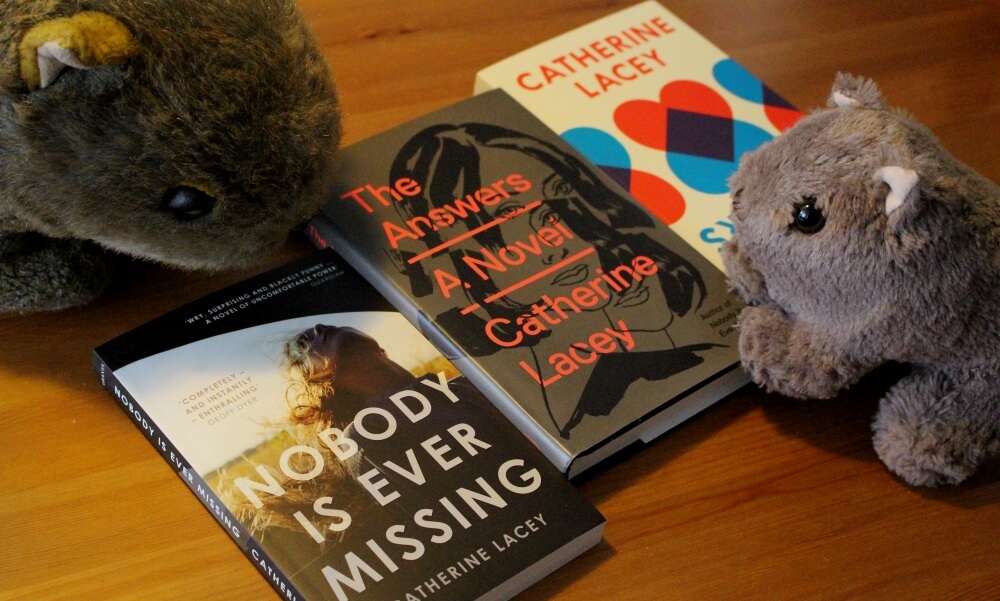
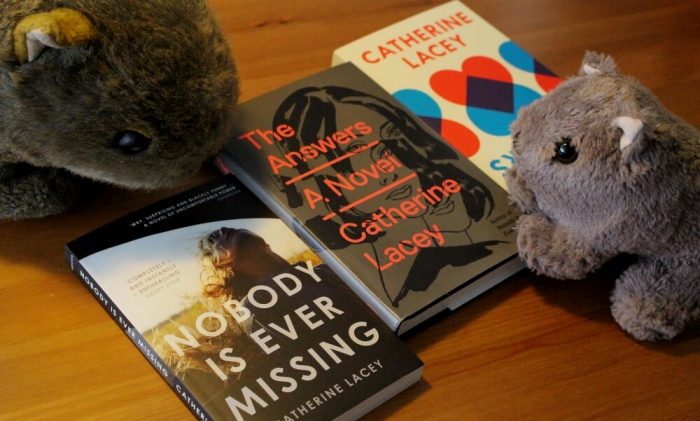
Inside I was delighted to find copies of The Answers by Catherine Lacey. This paperback version had a different cover to the American first edition hardcover I had gone out of my way to secure while we had been stateside. It was while comparing the two covers in my head that it occurred to me: if they’re selling her book, she must be at the festival!
Having had a parallel thought (how quickly did we re-harmonize those melodies?), The Girl was on her phone and checking the festival schedule.
“So… she’s on a panel in five minutes,” she said.
Catherine had been touring the USA while The Girl and I were stateside, but none of her appearances aligned with our travel itinerary. In a few instances, we only missed her being in the same city as us by one day. Now here we were, six weeks later, in Brisbane – my first edition of The Answers in my backpack at the hotel – having stumbled upon her entirely by accident. On the other side of the world. In a city we didn’t know we’d be visiting even three days prior. At a festival we didn’t know was happening. In a location we hadn’t specifically intended to visit.
Even removed from the context of the many strange coincidences that saw us sitting there to see it, the panel was wholly fascinating. Catherine and two other authors – Jeff Sparrow and Peter Polites – were discussing the books that had changed them through the years. Prompted by an audience question about being read to as an adult, Catherine spoke at length about her and her partner reading aloud to one another and the intimate nature of doing so. The Girl and I gave each other meaningful looks. It was clear what we both wanted to try out that evening.
Although Catherine and I hail from the two states at the bottom of the education attainment rankings (her Mississippi is #49 while my West Virginia unfortunately anchors the rankings), it seemed as though our experiences in regard to reading and literacy had been meaningfully different. She stated that she was lucky to have parents who read to her; that she knew kids whose parents did not know how to read to them. Catherine and I are removed in age by less than a year and grew up in states with statistically similar education and literacy troubles, and yet the possibility of encountering an illiterate adult was entirely outside of my experience when growing up. Hearing her speak on this topic was a gut punch, and it touched a nerve that has long been haunting me.*
Toward the end of the panel, Catherine noted how easy it is for a reader to feel as if they already know an author of a book they love; to feel as if they’re friends with the author. She made a joke about how the subtext of meeting a beloved author is along the lines of ‘you don’t know it yet, but we already know each other!’ This got a good laugh from a room full of people who would have lived many similar moments.
For my part, I don’t presume to know Catherine personally because of my appreciation for her writing, but I certainly have a kind of relationship with the writing itself. Her first novel Nobody Is Ever Missing was one of those miracle books that finds you just when you need it. I encountered it on the Staff Picks shelf at Better Read Than Dead while mired in a day job that was doing a lot to underscore how I’m not built to work a non-creative job. I was drawn into the book that same day, enchanted by the long but lyrical sentences** that represented the thoughts of a character who seemed to think in the same manner I do. I was intrigued by the New Zealand setting, the country from which The Girl’s parents hail but which I had never hopped on the three-hour flight to visit. When my studies would finally afford me the opportunity to make that journey late last year, my travels would be informed by Nobody Is Ever Missing. Specifically, I had not known that there was a ferry between the North and South islands of New Zealand until I read the book. When I rode that ferry myself, the novel was very much on my mind.
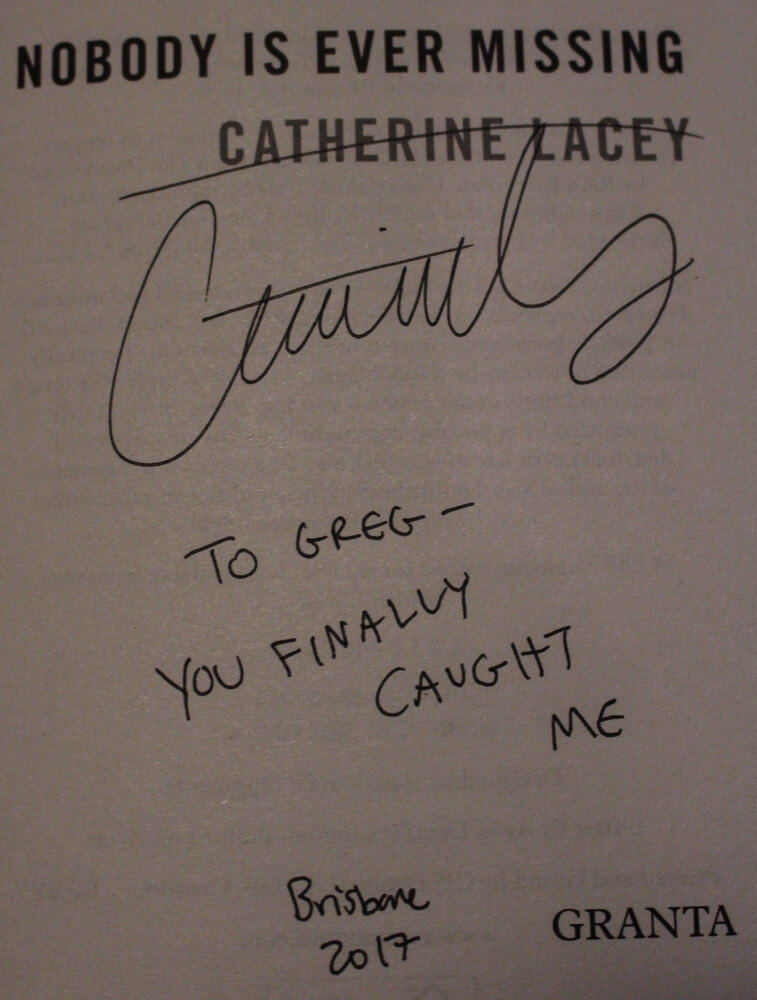
Of course, I reduced all of this to a “personal connection” to the book when I finally got to meet Catherine after the panel. I regretted not having my first edition of The Answers for her to sign, but she very graciously signed the paperbacks of both her novels that I had bought that day. The one personal story that I did relay to her was that of our many near-misses in the USA. This, of course, was me knowing her in a way that she had not yet been privy to. She seemed impressed and delighted that I had finally caught her, and she noted as much when she signed Nobody Is Ever Missing for me:
It was a perfect and random extension of a theme from our USA trip, and the magic of it was not lost on The Girl or I.
If you need us, we’ll be reading aloud to each other from The Answers.
* This difference in experience is rather easy to explain. The area of West Virginia in which I was born and raised would be a positive outlier in the education attainment statistics of the state as a whole. The (public) high school that I attended is a mainstay in the top ten percent of schools in the state and the local economy is buoyed by technical jobs that require advanced training, if not formal education. Although you wouldn’t have to drive very far outside of my home county to start encountering higher illiteracy rates, such a concern was (thankfully) not a part of my experience when growing up.
That said, such realities have not escaped my attention in my adult life. This is the haunted nerve about which I write above. Since moving to Australia in 2009, I have mostly escaped negative stereotypes associated with Appalachian Americans in general and West Virginians in particular. If a person here knows of West Virginia at all, that knowledge typically begins and ends with an appreciation for John Denver’s “Take Me Home, Country Roads” (and they’ll often sing the chorus to me). This has afforded me the opportunity to observe my home state from a safe distance; an almost entirely non-defensive position. It’s a subject for another post, naturally, but hearing about Catherine’s experience did pinch that haunted nerve in a compellingly different manner.
** Among my friends who very loyally read most of my writing, I am notorious for writing long sentences. When I mentioned an idea for a new novel, one of these friends joked that they looked forward to reading that single, very long sentence. I told Catherine this, and that I point to Nobody Is Ever Missing – which features sentences that go on for pages at a time – as an example of long sentences that work. She laughed and said “Yes! It can be done!”
-
A Familiar Nostalgia For SFMOMA
The girl and I spent an incredible day at SFMOMA (San Francisco Museum of Modern Art) yesterday, including hours in the Mike Mandel and Larry Sultan photography exhibits alone. Flipping through Sultan’s ‘loose’ photos was ceaselessly fascinating.
As always, the visit was too short. I find myself draped in a familiar nostalgia and anticipating my next day there.
-
The Neglected Pages Of My Notebook
I’ve been struggling to get any creative writing done over the past few months. The PhD life has been consuming all of that cognitive energy.
Unfortunately, that hasn’t slowed the ideas for stories – they now sit on the neglected pages of my notebook and taunt me from across the room. A collaboration with a dear friend, a few personal essays, and – most dangerous of all – a novel. We shall see.
I hope you’re well, friends.
-
Polar Stampede
Detail of ‘Polar Stampede’ by Lee Krasner (1960).
Clearly feeling nostalgic for the SFMOMA.
-
Black And White Mood
I’m in a black and white mood.
-
Ali Barter And The Listlessness Of Being
Sometime in early 2016 I was sitting in Wheat Café in Newtown when I heard a catchy tune cascading from the speakers inside. It had everything that initially attracts me to new music: unique vocals, face-melting guitar and a clean structure that builds to an explosive finish. It turned out to be Far Away by Ali Barter and upon repeat listens I began to feel like it was a song written about me; a song that gave definition to a certain kind of listlessness that not infrequently colors my days (“Spent too much time on freeways and internet / I’ve never felt so far away”).
As it turns out, Ali Barter had me right where she wanted me.
In The Myth of Sisyphus, the French-Algerian philosopher and writer Albert Camus examines the nature of what he calls “the absurd man”. In short, an absurd person is one who has accepted that life itself is inherently meaningless (that is: absurd). One example of an absurd life that Camus explores in the essay is that of the actor. To Camus, the actor is an absurd person whose interest in theatrical shows is concerned with the limitless potentialities that it offers them to live other lives. On the stage, the absurd person can live a thousand lives in the span of one actual lifetime, allowing them to “accept the poetry without feeling the sorrow.”
The absurd man begins where [the thoughtless man] leaves off, where… the mind wants to enter in.
Though I am no actor, this notion of “entering in” reflects the way that I interact with art in all forms. When an artist or an artwork seizes my attention, I want to know more about it. I want to understand the motivation behind it. I want to know what made it it. Put simply: my “mind wants to enter in.” Anybody who has ever gone straight to Wikipedia after watching a movie that was “based on a true story” knows the feeling that I’m alluding to here.
So I do “enter in” and immerse myself in these other worlds. Every now and again (though not frequently enough for my tastes) I encounter likeminded people when I arrive there. In the same way that actors meet other actors on a stage, so do I sometimes encounter others who seem to share my reality; others whose minds have likewise “enter[ed] in”.
Having “entered in” to the work of Ali Barter, I found not only Ali herself but also the worlds that she defines through her art. Considered individually or as a total body of work, Barter’s songs define worlds in a way that reveal her as a thinker against Camus’ criteria:
To think is first of all to create a world (or to limit one’s own world, which comes to the same thing).
It would seem that these are indeed Barter’s methods, and she uses the two interchangeably. In any given song she’ll either create a world from scratch (as in songs like Marigold and Run You Down) or – more often – she’ll bring in the boundaries of observable reality (as in Cigarette and Far Away) to create a digestible slice of reality that is representative of all the other slices. In either case, the world that Barter creates ends up feeling like the world in which you live.
By creating these familiar worlds, Ali Barter is hoping to grant you the freedom to live within them. In his essay, Camus examines Dostoevsky’s character of Kirilov as a case study of the existential freedom that comes with embracing absurdity. Camus writes about the possibility of becoming a “tsar” by living with absurdity within a practical life and thusly being “covered in glory”. Kirilov aims to grant others this same freedom by committing suicide (thereby proving that the freedom is absolute) but Barter doesn’t need to make a martyr of herself to accomplish the same end. For her, it is enough to acknowledge the inherent absurdity of modern life – the listlessness, if not exactly meaninglessness – so that we can each take the next step on solid footing.
This listlessness, then, becomes a common theme in her songs (and thus, her worlds). In Far Away she observes that “People walk in a trance / They never listen.” Her character (being a version of herself) in the video for Hypercolour rocks out for a crowd whose disinterest in her performance is painfully obvious to her (“I spent the summer in darkness pining for sun”). Meanwhile, Ode 2 Summa perfectly captures the aimlessness of a sweltering summer day (“Life’s a bitch and then you die / But it’s too hot to fuck, too hot to sing”) and her latest single Cigarette finds Barter’s avatar/character “Tired of standing next to you / With nobody caring what I do.”
Ali knows that each of these characters possesses the freedom that comes with absurdity, yet she is also very aware that this freedom is rarely exercised. If these worlds feel a little familiar, don’t fool yourself into thinking it’s some deceptive trick – these are absolutely the worlds in which you already live. They are the stages of theatres that Barter is inviting you to share with her – stages on which you can both live as tsars covered in glory if you can learn to endure your freedom.
If you see a little of yourself in one or more (or maybe all) of these listless characters, then you are – as I was – right where Ali Barter wants you. Her songs end up sounding like ones that you would write about your own life if you happened to be a musician; they seem as if they’re about your own personal experience. Not in the way that songs with universal appeal sound like they’re “about us” by serving as a mirror in which we can see ourselves, but rather as a painting – rendered by another hand – of something undeniably and unshakably familiar. They are about everybody at once while also being about nobody in particular and yet they feel deeply personal – so much so, in fact, that it’s easy to become quite possessive of them.
https://www.instagram.com/p/BXeyjooAtSd/
If it’s a musical sleight of hand, it’s not one executed to trick you but rather to awaken you to your surroundings. Without putting limits on herself as an artist, Barter invites you to enjoy her songs on any level. Each is insanely catchy, built on an intoxicating sound and constructed with a tried-and-true structure. This is enjoyable enough on a superficial level, but she rewards those who are willing to look deeper and examine the subtext of the worlds she’s invited you to share with her.
Ali accomplishes this in a few different ways, but always with simplistic strokes. In Community she employs melancholy and nostalgia in framing a night out as a quest for inclusion and connection; for belonging.
Community reminds one of the story of Sisyphus, whose struggle Camus examines in his essay. Sisyphus was doomed to push a massive boulder up a mountain only to see it roll back down, requiring him to push it up the mountain again and again in futile and eternal repetition. The character in Community likewise seems to have been pushing a metaphorical boulder (“Drink myself to death on a Saturday night”) up the same mountain over and over again (“Give me everything and more / You know it’s never enough”). It’s a pattern, Ali knows, that we all get stuck in from time to time.
By mining these familiar truths, Barter accomplishes what Camus considers in his essay to be the “good” relationship between the artist’s experience and the work that inevitably reflects it:
That relationship is good when the work is but a piece cut out of experience, a facet of the diamond in which the inner luster is epitomized without being limited.
Whether you consider the character in Community to be you, Barter, your best friend, or some faceless fictional partier matters not. What matters, Camus tells us, is whether or not you think the character is finding pleasure in the face of this repeated struggle.
One must imagine Sisyphus happy.
On the surface Community is a “celebration of the ordinary” that would please Camus – a tribute to good times (perhaps enjoyed in pre-lockout Kings Cross, where the video for the song was filmed) – but there are clearly layers to the worlds Barter has created here and in other songs.
Consider the example of Girlie Bits, one of Barter’s most popular tunes. The song has been popularly described as a “feminist anthem” and it certainly sounds like one (this, of course, being merely the surface layer). While this label isn’t at all inaccurate (or, I imagine, unwelcome by Barter), it doesn’t totally capture the subtly powerful manner in which the song goes about being such an anthem.
Girlie Bits doesn’t yell at you, call anybody out, or tell anybody what to do. The song doesn’t operate on the assumption that any of sexist attitudes referred to in the lyrics (“Give us a smile, Princess / It’s better for business”) will come as a shock to you. In fact, Barter is betting that it will all seem very familiar indeed to male and female listeners alike; that these examples of the ways in which women are frequently marginalized are so prevalent in our society that the unenlightened eye might mistake them as being normal. This world is absolutely your world and the subtext (that is, the “inner luster” layer) becomes immediately and painfully clear: we see (and/or suffer) these injustices with frequency – so what are we going to do about it?
Barter, for her part, isn’t stopping with songs that might make us reconsider the actions of our skeevier acquaintances. For the past few months she’s been using short but moving posts on her Facebook page to highlight the powerful female singers (which she calls History Grrrls) that have inspired her through the years. In longer form she’s been railing against a musical status quo that has been perpetuated by a historical narrative that often refuses to see female musicians as legitimate artists. It’s easy to see that she’s trying to create and step into a role of an empowerment agent that she had to go largely without in her own developmental years. By taking on this role, she hopes the female artists of tomorrow will grow up in a world where the legitimacy of their work is never questioned.
Importantly, she recognizes that her role as an artist is inextricable from her role as a person. Camus highlights the importance of this relationship in his exploration of absurdist creation. He posits that an absurd artist is not so different from a philosopher:
The idea of an art detached from its creator is not only outmoded; it is false.
For the same reason as the thinker, the artist commits himself and becomes himself in his work.
This much holds true with Barter. As seen in the example of the subtext found in Girlie Bits and how this aligns with her interest in advancing a discourse toward achieving gender equity, Barter is as much thinker as artist and these two modes of her intellect are inextricably linked. Girlie Bits loses its bite if it’s not written by Barter and Barter can’t disrupt the status quo in a manner authentic to her own ideas without writing Girlie Bits.
All of that to say: whatever you think of it otherwise, Girlie Bits is more than “just a song”. It’s a song written by a certain person in a certain way under certain circumstances and for a specific reason. To merely listen to the song (or any of her others) and not consider these circumstances (the art as an extension of the artist) is to miss what she’s freely and nakedly offering you. It’s akin to walking into the cinema late and seeing only the end of the movie.
If Ali Barter the person can’t be removed from the songs of Ali Barter, then those same songs have the effect of making you feel as if you grew up alongside her. Each track becomes an existential comfort zone into which you can settle and allow the rhythm to wash over you or from which – on a different day, having finally seen something that Barter has already mined for “internal luster” – you can launch your revolt against inequity, an aloof romantic partner, a hot summer day, consumerism, or the fear of missing out.
Ali’s songs (and by extension, her worlds) are – in spite of the meaninglessness they acknowledge but refuse to succumb to – ultimately hopeful. In this way her art avoids being absurd in the purest sense, but even Camus recognises “that hope cannot be eluded forever” and this speaks again to the freedom that Ali would like us all to recognise that we possess. Even Sisyphus, bound as he is to his eternal fate, enjoys – within that “world” – absurdist freedom and is thereby capable of happiness. The key, as we have seen, is that he uses his freedom to choose that happiness.
Like those of us caught exactly where Ali wants us, her character in Cigarette is beginning to notice that something about her reality is a bit sterile. Here Ali has tightened the fences of reality on a character who is only just beginning to become fully aware of the form those fences take: in this case, gender normative romantic expectations and the mundanity of merely “being”. She wonders what measures would be necessary to escape these shackles (“If I shaved my head would you / Tell your friends you don’t really care / Really care”) but by the time she’s warning the unidentified “other” in the song to not ask her for a cigarette, it becomes clear that such measures aren’t necessary. She need not replicate the gesture of Kirilov’s suicide in order to obtain her freedom, she need only to embrace that she has always possessed that freedom.
To paraphrase her own words that I quoted at the beginning of this piece: as well as she understands the energy it takes to have to face these feelings every day, she also knows she’s not the only one who wakes up trying not to feel that way. By illustrating that we all possess the freedom of Ali Barter the person, artist and avatar – and that we need only choose happiness, as Camus would like us to believe Sisyphus did – she reveals herself as something vitally important in the present moment: a conqueror.
From Camus:
The conquerors are merely those among [us] who are conscious enough of their strength to be sure of living constantly on those heights and fully aware of that grandeur.
Ali Barter chooses revolt rather than surrender – to live fully and happily as a tsar covered in glory – in the face of inherent meaninglessness. Each of her songs is an invitation for us to do the same and we all possess the freedom to accept that invitation. All that remains is to choose to do so.
Greg Joachim is a writer of fiction and non-fiction when not working as a PhD candidate and academic at the University of Technology Sydney. He resides in Sydney with his wife, Claire.
Reach out on Twitter: @gregjoachim
-
Filtering Gloom
Angry sky. Filtering gloom through a sense of foreboding. My work continues.
-
Time According To Window Washers
Working and writing from home today. Measuring time by the progress of the window cleaners across the street.